
Budget transparency and program budgeting represent an important part of public finance reforms that Bosnia and Herzegovina should implement in the process of European integration and alignment with the requirements of Chapter 32 – Financial control.
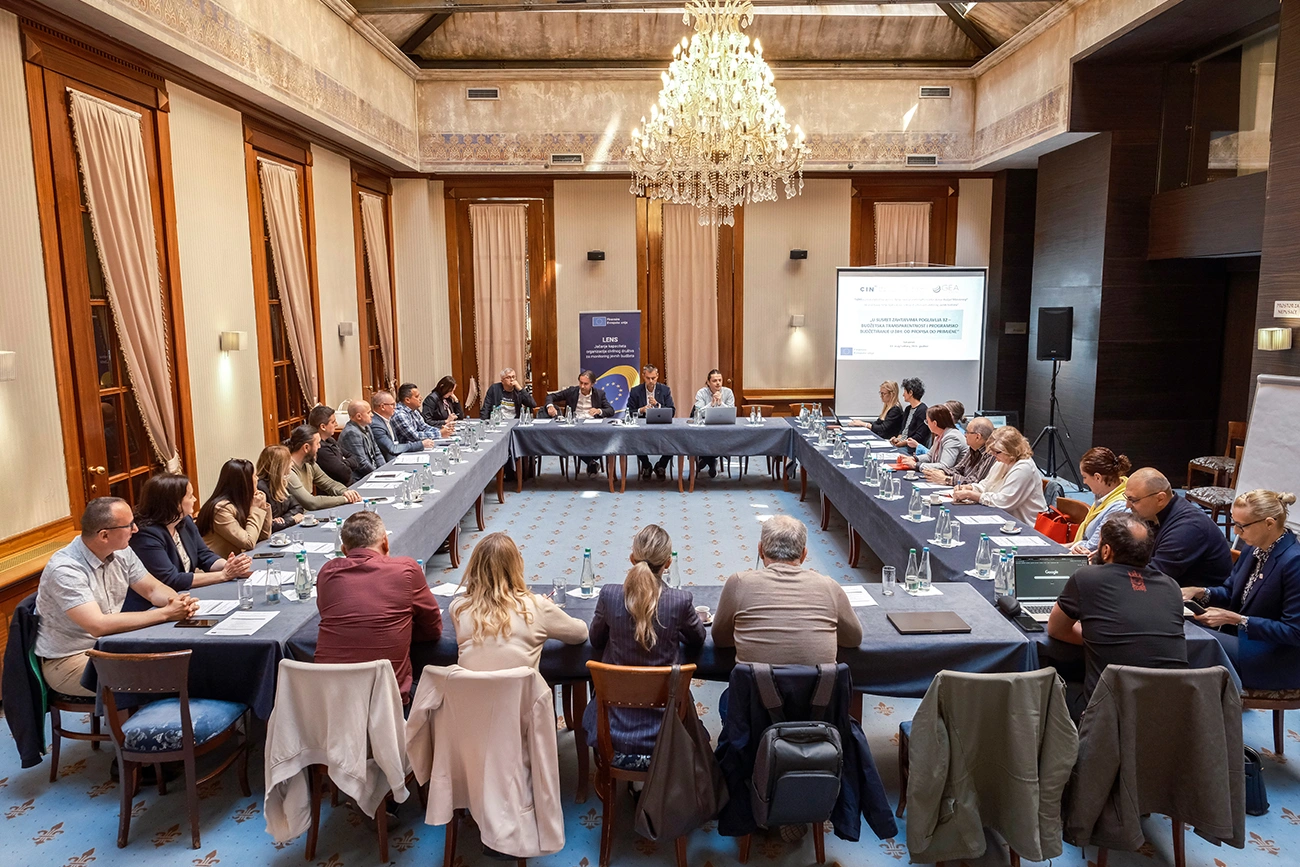
These topics were the focus of the round table Towards the requirements of Chapter 32 – Budget transparency and program budgeting: from regulations to implementation, which brought together representatives of institutions of all levels of government, civil society organizations and international partners.
The participants discussed what the requirements of Chapter 32 specifically mean for Bosnia and Herzegovina, especially in terms of improving the transparency of public finances, strengthening institutional accountability and establishing a more efficient system of program budgeting, focused on the results and effects of public spending. Special emphasis was placed on the need for budget processes to become more understandable and accessible to citizens, as well as for budgets to be more clearly linked to strategic goals and concrete results of public policies.
During the discussion, the participants presented experiences and challenges related to the implementation of existing regulations and methodologies in the areas of budget transparency and program budgeting. It was pointed out that, despite some progress in the publication of budget documents and the development of the regulatory framework, practice still shows significant differences between institutions and levels of government. One of the key challenges is the limited connection between budget allocations and clearly defined results and performance indicators, which makes it difficult to monitor the effects of public spending and assess the effectiveness of policies and programs.
Representatives of institutions, civil society and international organizations particularly emphasized that obstacles to effective program budgeting include insufficient administrative and technical capacities, limited analytical resources, uneven application of methodologies, as well as the need for additional training and continuous support to institutions implementing budget reforms. It was also pointed out that transparency does not only mean the formal publication of budget documents, but also their availability in open, comprehensible and citizen-friendly formats.
In the final part of the round table, a joint discussion was held on recommendations and concrete steps for improving the public finance system in Bosnia and Herzegovina. The participants emphasized the need to strengthen the connection between the budget, strategic priorities and measurable results, improve the availability of open budget data, develop digital tools for communication with citizens and ensure stronger involvement of civil society and the professional community in budget processes. The importance of inter-institutional cooperation and continuous dialogue between institutions, civil society and international partners was also highlighted in order for reform processes to be sustainable and aimed at concrete results.
The round table was organized as part of activities aimed at strengthening the dialogue and exchange of experiences on the reform of public finance management and the improvement of budget transparency in Bosnia and Herzegovina, carried out by the Center for Investigative Journalism (CIN) with partner organizations “Futura” from Mostar and the Center for Research and Studies – GEA from Banja Luka within the project LENS – Strengthening the capacity of civil society organizations to monitor public budgets funded by the European Union.
The goal of the project is to contribute to the fight against corruption by increasing the level of monitoring budget spending and the use of public funds at the local level, with the active participation of civil society.